Coir Geotextiles in Roads to Reinforce The Subsoil Beneath
Coir geotextiles in roads – Indonesia has considerable coconut production potential as a tropical country. The area of coconut plantations reaches 3,654,478 hectares with a total production of around 3,051,585 tons (DitJenbun, 2014), 99% of which is cultivated by small farmers. Apart from being used for domestic consumption. Several coconut commodities are exported, and foreign exchanged. The coconut was also brought in commodities that can be utilized as a source of the national economy.
- The coconut plant has many benefits:
- The young leaves are used to food warp.
- We can cook the flowers as a side dish.
- Coconut water and flesh give us natural freshness if we drink them.
- Coconut tree trunks can be used as building poles.
- Even the roots can still be used as handicrafts and much more.
Undoubtedly, the Scout organization uses the coconut bud or coconut tuna logo because of their philosophy that every part of the coconut tree can be used for human life. Likewise, scout members are expected to be efficient for the state and nation of Indonesia at every age.
Nothing Waste from Every Single Part of Coconut Plants
The coconut plant is nicknamed the “Tree of Life” because all plant parts can be used. In Indonesia, coconut is an important plantation product because it supports millions of people and makes it a valuable asset. Coconut is a social and economic good. When the price of goods changes. It has a direct effect on the livelihoods of agriculturalists.
Coconut husk helps improve soil structure and acts like a sponge to hold air, which is helpful for plants. Coconut water’swater’s carrying capacity is better than most other soil substitutes and can maintain 7-10 times its weight. This way, coconut coir can be utilized as a planting medium and additional nutrients for the soil.
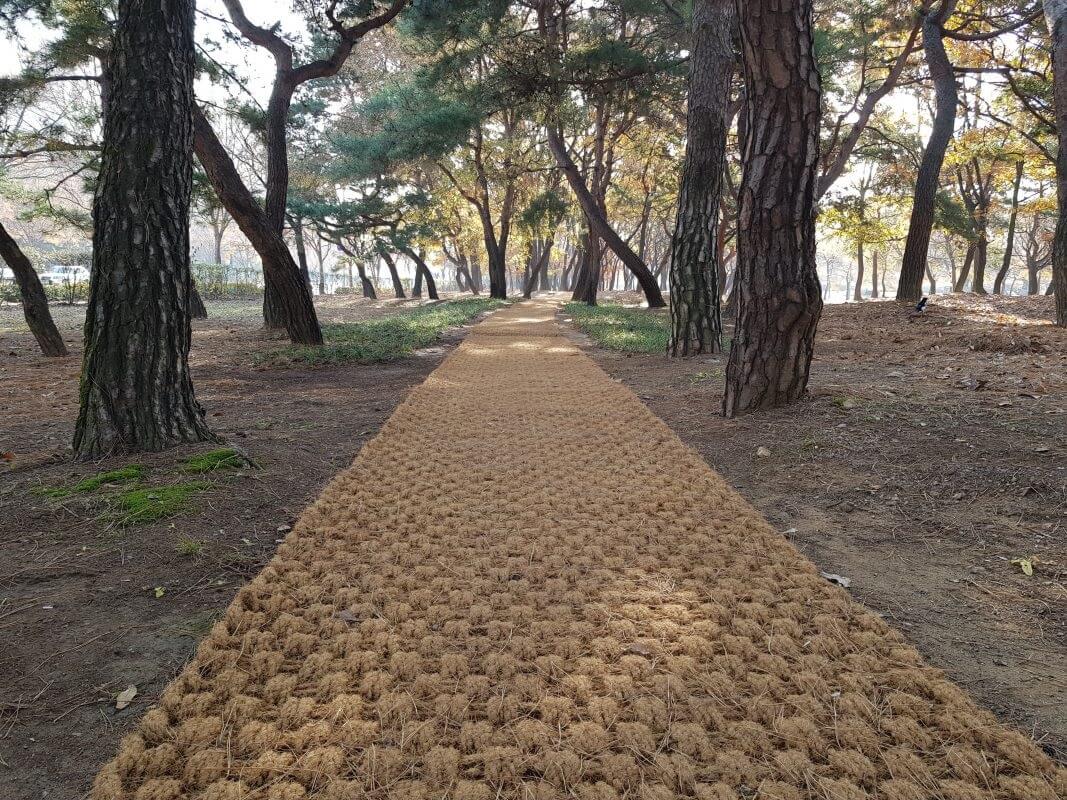
Along with technological developments in the past, it turns out that coconut coir can be processed into products with high economic value and even become commodities that can penetrate international markets. One of them is cocomesh or coir net or coconut coir net. Coconut coir nets handle critical land, reclamation of ex-mining areas, relegating slope land and watersheds, and so on. Adjusting and modifying the shape and size of the coconut coir nets can be used for road paving.
Reinforce Ground Base using Coir Geotextiles in Roads
The material for coir nets is cheap, easy to find, easy to apply in the field, and biodegradable. Coir-net or coconut coir geotextiles can also be used for geotechnical engineering or paving. They can also be used as an overlay or innerlay. It can protect against airflow runoff and strengthen embankment, filtration, and drainage.
Coconut coir nets are spread directly on the ground to be used as roads. First, the land is roughly leveled, then a coir net is applied. Coir net is an alternative solution for road paving because it is made from natural materials, namely coconut coir waste. The material is strong but can be degraded by the soil, so it is safe for the ecosystem compared to mixed lime/limestone, cement, etc.
Read also the next interesting article, This is The Recipe of Pink Green Coconut Milk Suitable for Desserts